


Scratches
The first scratch on a new wedding ring is the moment it becomes real.

Three couples. Three rings. Three different definitions of wear.
The ring arrives flawless. A surface that catches the light with almost architectural precision – every angle considered, every curve deliberate. You put it on, and in that moment the ring is an object of pure design. Then life begins.
The first scratch comes sooner than expected – usually within the first month, sometimes in the very first week. You notice it. You run your finger over it. And then, slowly, it dawns on you: this isn’t damage. This is the beginning of the ring. Three couples, three rings – and in the end, three surfaces that no one could ever recreate.
Five years – Sarah’s ring

Sarah’s ring is five years old. A flat white gold band, 3 mm wide, which she has worn every day since she married Tom in a garden one August. It has survived two pregnancies, a house renovation and roughly 1,825 applications of hand sanitizer.
“At first I worried about scratches,” she says. “I always thought I should take it off for gardening, for sports, for anything that might damage it. Then I realized: if I’m forever taking it off, I’ll lose it at some point – or I’ll spend five years worrying about a ring instead of wearing it.”
The ring now has a surface that a jeweler would describe as “showing signs of wear” and that Sarah describes as “looking like mine.”
Twenty years – James’s ring
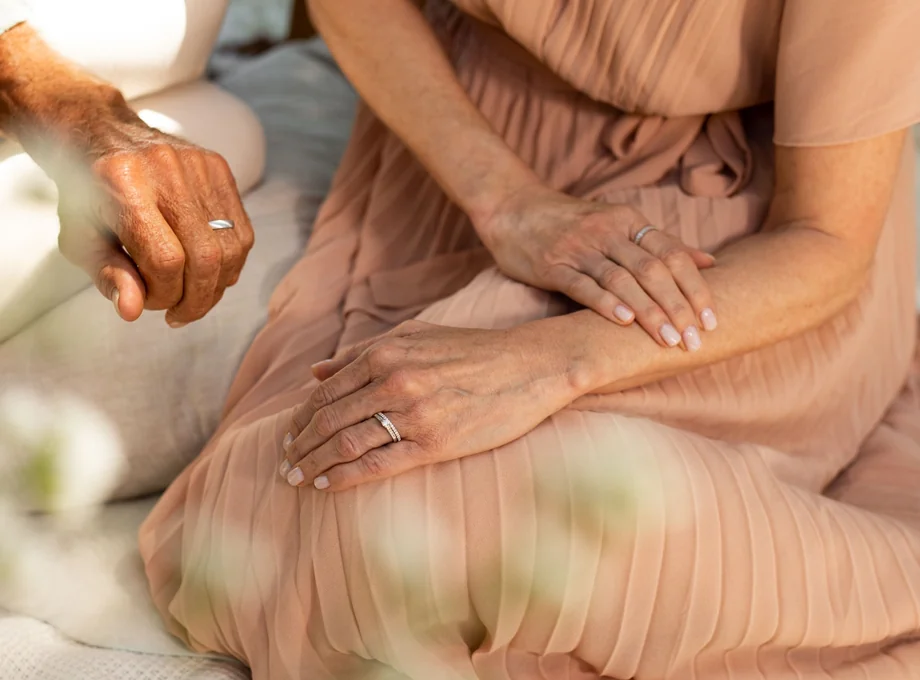
James’s ring is yellow gold, 5 mm, with a comfort-fit inner profile – a model he chose because it felt the most comfortable for everyday wear. He works with his hands. The ring has worked alongside him.
“It looks completely different from when I bought it,” he says. “Which is exactly what I’d hoped for.”
The surface has evolved from polished to what jewelers call “satin” – a soft, diffuse texture created not by design, but by two decades of daily contact with the world. No individual scratches are visible anymore. Instead, a cumulative effect: the ring has been polished by life, not by machines.
Forty years – Margaret’s ring

Margaret’s ring is yellow gold, bought in 1984 and worn every day since. She has had it resized twice – once after the birth of each of her children – and polished once, around fifteen years ago, at a jeweler’s insistence.
“It was too bright,” she says. “It didn’t look like my ring anymore. It looked like someone else’s ring on my finger. I waited until it went matte again, which took about six months – and after that, I left it alone.”
The ring now has a warmth and softness that new gold doesn’t have. It isn’t the color of gold. It is the color of this gold, this ring, these forty years.
The first scratch is not the beginning of the end. It is the end of the beginning. It is the moment the ring stops being an object – and starts being yours.

